I got a notification from Robinhood in December 2025. "NBA season tips off soon," it said. "Place your bets."
I stared at my phone for a minute. When did Robinhood start doing sports betting?
Turns out, March 2024. I'd somehow missed it. They started with election betting, then added college basketball, then NFL games. By December they were offering parlays and prop bets on individual player performance. You can bet on whether Patrick Mahomes will throw for over 250 yards. In the same app where you buy index funds.
I actually started writing this post back in 2022. Then I got busy and shelved it. The original draft was about options trading and gamification. About how Robinhood was turning investing into a game. About the confetti animations and the free stock scratch-offs and all the psychological tricks they used to make trading feel fun instead of risky.
That version feels quaint now. They've gone so much further.
What They Got Right
Here's the thing. Robinhood genuinely changed the industry. Before them, every trade cost seven to ten dollars. That's a huge barrier when you're starting with a hundred bucks. A single trade could eat 10% of your capital.
They made it free. And they made it beautiful. The app was actually pleasant to use, which sounds superficial but matters enormously when you're trying to get people to overcome their fear of investing. Traditional broker apps looked like they were designed in 1997 by people who hated their users.
Within two years, every major brokerage dropped their commissions to zero. Schwab, Fidelity, E-Trade. All of them. Robinhood forced the entire industry to change.
That's real. The mission to "democratize finance" seemed genuine. Two immigrant kids from Stanford saw that rich people paid nothing to trade while regular people got charged every time. They fixed it.
I give them credit for that. I really do.
"We're on a mission to democratize finance for all."
The Slow Drift
But somewhere between 2015 and 2025, something changed.
Look at the timeline:
The Drift: 2015-2025
Let me sit with that for a second. In 2020, they got sued for making investing feel too much like a game. They removed the confetti. Then in 2024, they added actual gambling.
Perfect.
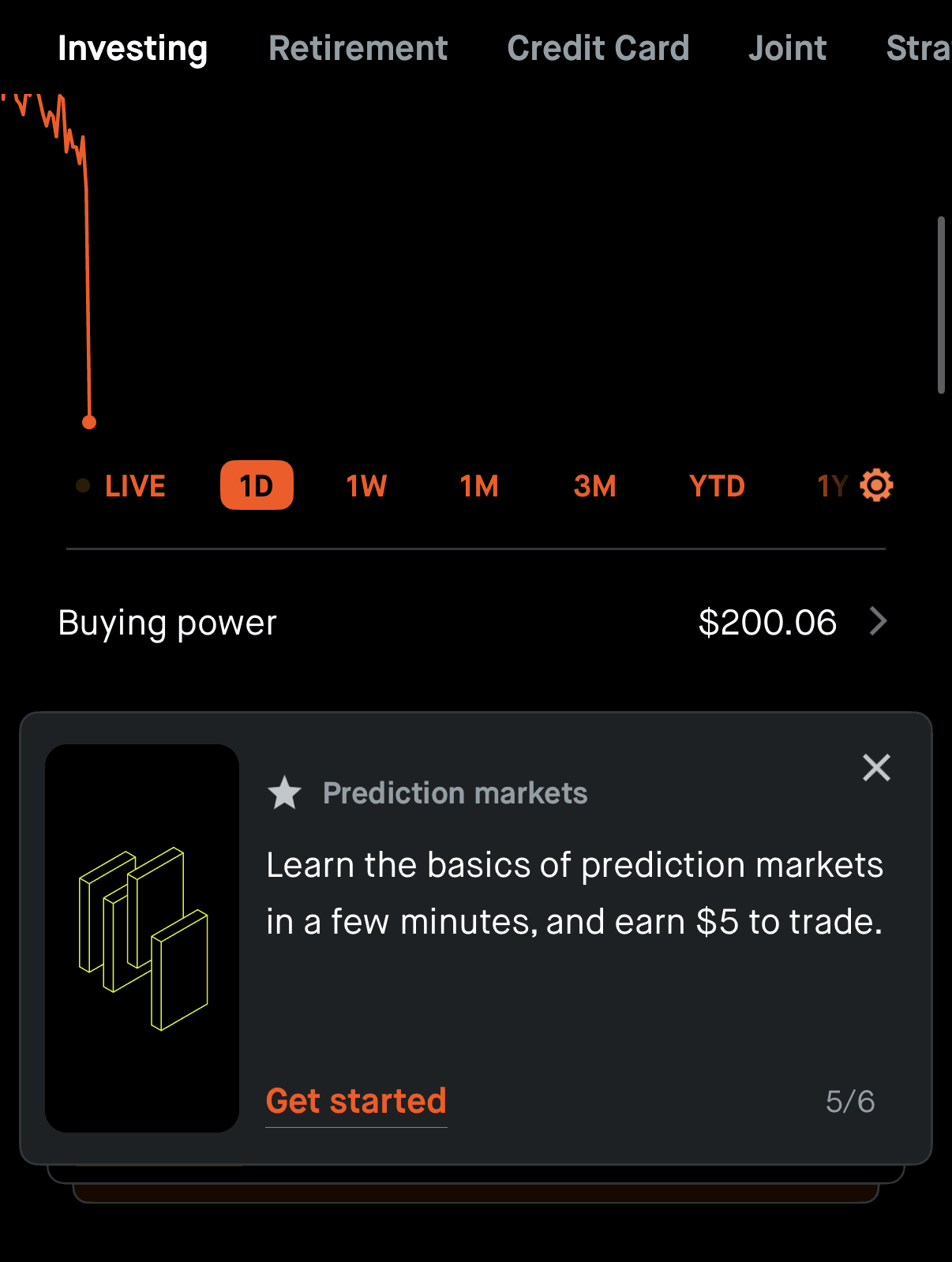
"Learn the basics of prediction markets in a few minutes, and earn $5 to trade." The gamification never stopped. It just got more sophisticated.
"Robinhood's aggressive tactics to attract inexperienced investors, its use of gamification strategies to manipulate customers, and its failure to prevent frequent outages on its trading platform."
March 2024
The prediction markets started innocuously enough. Presidential election contracts. Will Trump or Harris win? You could argue there's some value in price discovery there. Markets are good at aggregating information.
Then August: NFL and college football.
Then December: Parlays. Prop bets. Player performance betting. All the same mechanics as DraftKings, just with different branding.
The results? Fastest growing product in company history.
Faster than commission-free trading. Faster than crypto during the 2021 boom. Faster than options during the WSB mania.
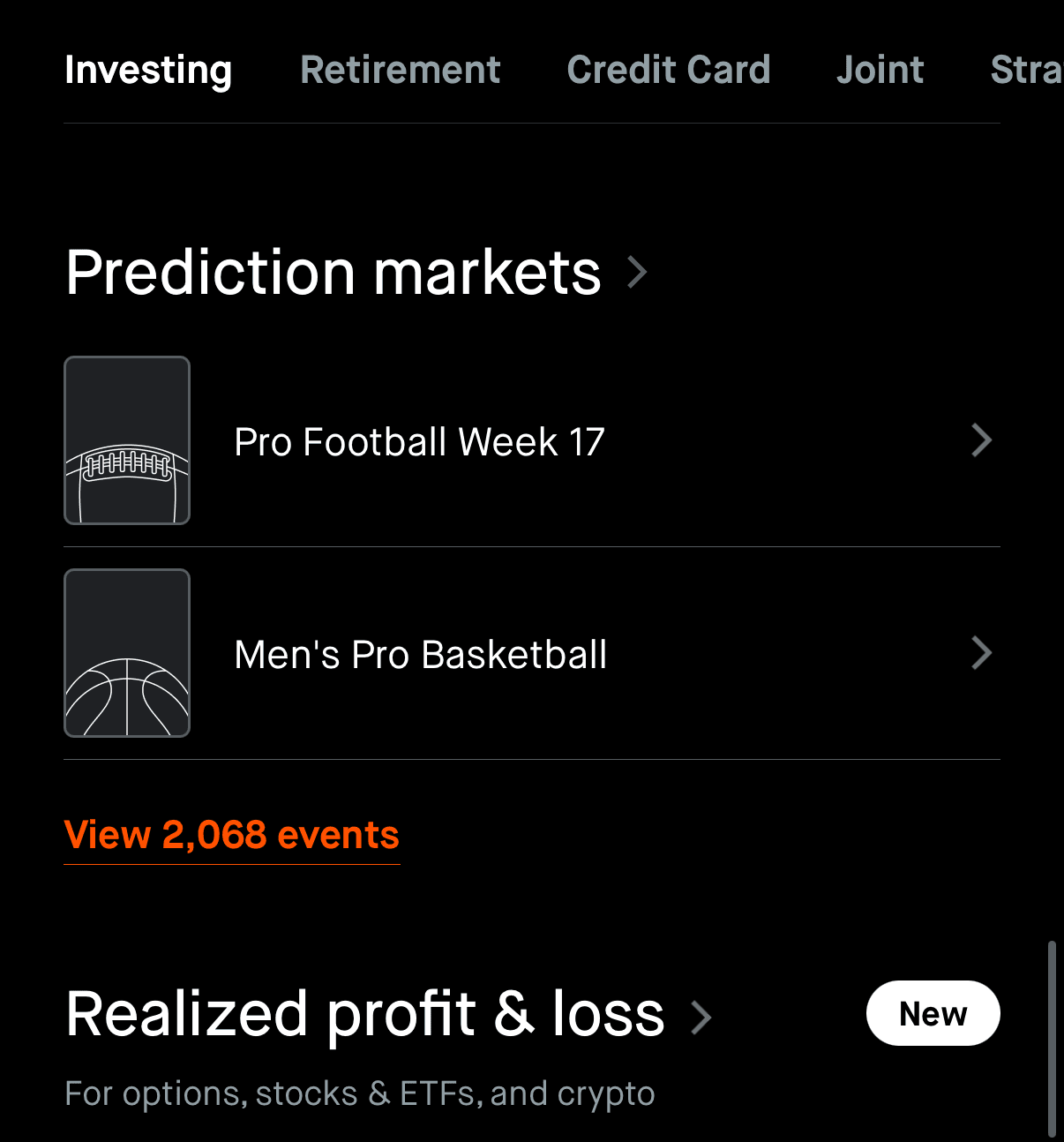
"View 2,068 events." This is what a sportsbook looks like. Notice the tab at the top still says "Investing."
Here's what bothers me about that screenshot. See the tab at the top? "Investing."
Robinhood put sports betting under the "Investing" tab. Not a separate section. Not a different app. Right there with your index funds and retirement accounts.
That's a choice. They could have made this a standalone feature. They chose not to. They chose to blur the line between investing and gambling as much as possible.
Prediction Markets by the Numbers (Nov 2025)
Fastest growing product in company history. In just 8 months.
The company's stock went up 220% in 2025. Analysts cited prediction markets as a major driver.
Here's what gets me: they made this available in all 50 states. Even the 12 states where sports betting is illegal. How? By calling it "trading" instead of "betting" and routing it through a CFTC-regulated exchange.
It's regulatory arbitrage. You can dress it up as "event contracts" and "price discovery" all you want. When I'm betting on whether the Chiefs will cover the spread, I'm gambling. Everyone knows this.
The Counterarguments
I can already hear the responses.
"Drew, the stock market IS a casino."
I get it. I've seen the loss porn on WallStreetBets. I know people blow up their accounts on 0DTE SPY options. I know day trading has the same odds as a slot machine.
But there's a difference between saying "some people use stocks to gamble" and building an actual sportsbook into your investing app.
When you buy a stock, even a meme stock, you own a piece of a business. That business might succeed or fail. But there's something real underneath. When you buy an index fund, you're participating in the growth of the economy over time. When you sell options, you're taking the other side of someone's hedging strategy.
Investing vs Sports Betting
| Criteria | Investing | Sports Betting |
|---|---|---|
| Average Return | 10% annually | House edge: -5% to -7% |
| 20-Year Profit Chance | ~95% | ~2% |
| Nature of Activity | Participates in economic growth | Pure zero-sum speculation |
| Long-Term Winners | Most people | The house |
These might be bad ideas. You might lose money. But they're connected to productive activity in some way.
What productive activity is served by betting on whether Steph Curry scores over 28.5 points?
"Prediction markets provide valuable price discovery."
Sure. For some things. Knowing the market's odds on an election has some informational value. Maybe even economic indicators.
But we're past that now. NFL parlays are price discovery for what exactly? The true probability that the Cowboys will win and the game will go over 47.5 points?
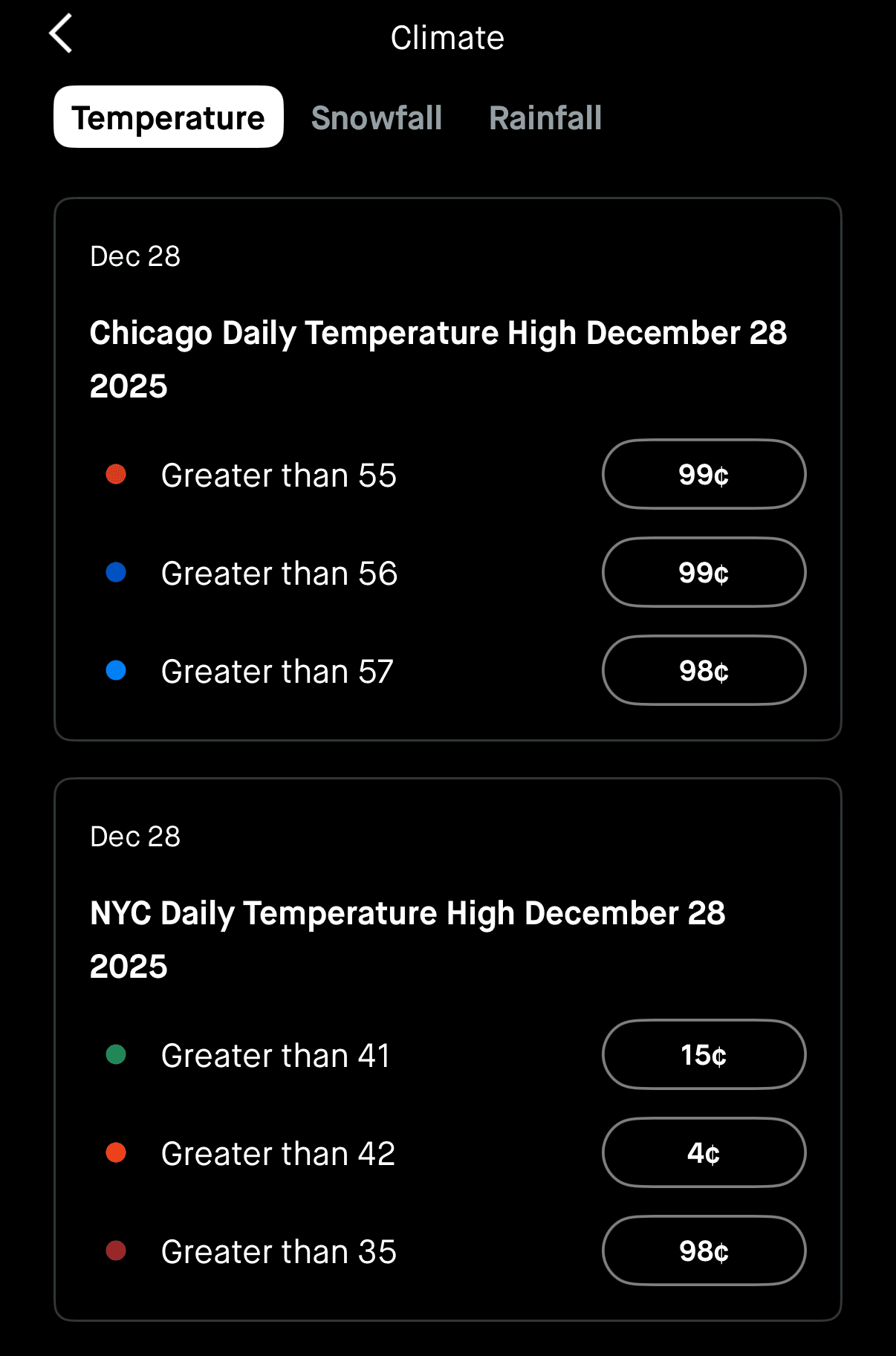
Climate predictions. You can bet on whether it'll be 56 degrees or 57 degrees in Chicago tomorrow. For 99 cents. What market inefficiency is being corrected here?
This is where the "price discovery" argument collapses completely.
What valuable information is the market discovering by letting me bet 99 cents on whether Chicago's high temperature will be greater than 55 degrees versus 56 degrees?
The weather forecast already exists. It's free. The National Weather Service publishes it. We don't need a prediction market to "discover" whether it'll be cold in Chicago in December.
This exists because someone will bet on it. That's the only reason. They've moved past even pretending this serves a social function.
Come on.
"Sports betting is already legal in most states."
True. And those states regulate it as gambling. Age verification, responsible gaming features, self-exclusion lists, the whole apparatus.
Robinhood made this available in ALL states by calling it something else. They took gambling and packaged it as trading. They put it in the same app where 22-year-olds are buying their first shares of VOO.
The line between "learning to invest" and "betting on the game" is now a swipe and a tap.
What Really Disappoints Me
I want to be clear about something. I'm not claiming moral high ground here. I use Robinhood myself for side investments. I trade options sometimes. I get the appeal.
I also understand the business logic. The market for sports betting exists. It's growing. Robinhood has 25 million users and a world-class product team. Why wouldn't they build this?
But understanding something is different from thinking it's the right call.
These guys are immigrants' kids. They built something that mattered. They actually changed finance in a way that helped millions of people.
They could have stayed focused on that mission. They could have said, "Our job is to help people build long-term wealth. We're good at removing friction from complex processes. Let's use that power for retirement accounts and financial education and boring, important stuff."
Instead they looked at their success with young investors and thought: "You know what these people need? NFL parlays."
They had a choice. Companies always have choices. Some companies draw lines. Patagonia could make more money but chooses not to maximize growth. Costco could cut employee benefits but doesn't.
Robinhood could have said no to the $300 million in gambling revenue. They didn't.
The Pattern Emerges
I wrote about this in my dopamine economy piece. The pattern repeats over and over:
- Find something people want.
- Remove all friction.
- Increase the potency.
- Extract value.
"Find something people want. Remove all friction. Increase the potency. Extract value."
Sports betting used to require driving to a track or calling a bookie. Real effort, real social friction. Now it's instant. In your pocket. Optimized to perfection.
Robinhood didn't invent mobile sports betting. But they're applying their considerable talent to making it as frictionless as possible. They're really good at UI/UX. They're using that skill to make gambling easier.
That's the thing that bothers me. They're competent. They could build anything. They chose this.
The prediction markets product became their fastest-growing product ever because gambling is more addictive than investing. Sports betting delivers more dopamine than stock picking. They built the best possible interface for the worst possible product.
The Rot Spreads
The gambling industry doesn't just build products. It acquires things.
FaZe Clan was one of the biggest esports organizations in the world. Gaming content, competitive teams, lifestyle brand. Millions of followers, mostly teenagers and young adults.
In 2023, they were struggling financially. Then Jason Robins, cofounder of DraftKings, became their new owner.
By December 2025, the organization was falling apart. FaZe Rug, one of their biggest creators, left. Five more followed. The issue? New contracts. New direction. The vibe changed.
Robins wanted to integrate betting content. Push prediction markets. Turn gaming entertainment into gambling-adjacent content. The creators said no. So they left.
This is what happens when gambling money enters adjacent spaces. It doesn't just participate. It tries to convert everything into its own image.
Gaming was supposed to be separate from gambling. Esports was competition, entertainment, community. Then the DraftKings money arrived. Now it's another distribution channel.
Robinhood did the same thing in reverse. They started with investing. Then they looked at their young user base and thought: these people would probably bet on sports. So they built the infrastructure.
The pattern is identical. Find a legitimate activity that young people love. Add gambling. Extract value.
What Could Have Been
I think about the alternate timeline sometimes.
Imagine if that product talent went into retirement planning. Into making it easier for people to understand compound interest. Into financial education that actually worked.
Imagine those 11 billion prediction market contracts were index fund purchases instead.
Imagine they'd looked at the $300 million revenue opportunity and said, "We're good. This doesn't serve our mission."
What They Built
- •11 billion gambling contracts
- •$300M betting revenue
- •Available in states where betting is illegal
- •Weather and sports parlays
What They Could Have Built
- •Automatic 401k rollovers
- •Financial literacy curriculum
- •Estate planning for regular people
- •Actual wealth democratization
I know how naive that sounds. Companies optimize for growth. Shareholders demand returns. The market exists whether Robinhood serves it or not.
But some companies do choose differently. The choice exists.
The Tell
You know what really reveals the truth? The speed.
Prediction markets grew faster than anything they've ever built. Faster than the product that made them famous. Faster than crypto at peak mania.
Product Growth Comparison (Year 1)
Prediction markets grew faster than everything—including crypto at peak mania.
That tells you something about what people really want from Robinhood. Or maybe what Robinhood has trained them to want.
They started as the company that would teach you to invest. They've become the company that makes it easy to bet on sports. These are not the same thing.
Still Here
I haven't deleted the app. I still use it for my fun money. Small positions, stuff I can afford to lose.
But I don't pretend anymore that they're the company from the mission statement. They're not democratizing finance. They're not helping people build wealth.
They're another dopamine merchant. Really well-designed. Beautifully executed. Still a dopamine merchant.
The saddest part? They didn't have to be.
"We're on a mission to democratize finance for all."
This essay was written in December 2025. All data current as of publication.